
🌐 English Version — 閱讀繁體中文版本 | English translation of our original Chinese article.
Affiliate disclosure: some booking links here pay me a commission at no cost to you. I also link to free tools and platforms that don’t pay me anything — because they’re genuinely useful. All prices and recommendations are from my own research.
A miscalculation that cost real money: I bought a 5-day T-money top-up of KRW60,000 for Seoul public transit. Used KRW28,000 of it. The unused balance — about NT$630 — can’t be transferred or refunded after you leave Korea. I’ve now started tracking my remaining balance more carefully on the last day.
Seoul has over 900 hotels rated 4 stars or above — but choosing which neighborhood to stay in will determine whether your trip is effortless or exhausting. I’ve watched too many travelers stand bewildered at the top of Hongdae Station Exit 9 with a 26-inch suitcase, silently regretting their hotel choice. Pick the right area and you could save 1.5 hours of commuting every day. Pick the wrong one and you’re not just walking more — you’re spending extra on taxis with a broken spirit.
This guide synthesized 200+ accommodation-related questions from reader forums, covering the most common neighborhood dilemmas: Hongdae, Myeongdong, Dongdaemun, Gangnam, and beyond. Every figure cited here is a real number, not hotel marketing logic.
One thing this article can’t fit: the “Seoul 6-District Subway Elevator/Escalator Master Cheat Sheet” — which exits have elevators, which stations let you avoid carrying luggage up stairs. That’s in the newsletter, once, no resends. 👉 Subscribe free
Honest caveat: “best Seoul neighborhood” is genuinely a personal-fit question, not an objective ranking. The four neighborhoods I cover (Hongdae, Myeongdong, Dongdaemun, Gangnam) all serve different traveler profiles — what’s “best” for a 24-year-old Korean drama fan visiting indie cafes is the worst choice for a 50-year-old business traveler with morning meetings. The trade-offs in this guide (transit time, noise, food access, English availability, price) are durable; the specific hotel recommendations within each neighborhood may shift with management changes. Pick the neighborhood profile that matches your trip, then verify the specific property’s recent reviews.
⚠️ Who shouldn’t follow this Seoul neighborhood approach
1. Travelers staying ≤2 nights with packed sightseeing. The neighborhood-fit optimization in this guide assumes 4+ nights — enough time to actually use a neighborhood’s character. For 1-2 night stays, just book whatever’s closest to your top 1-2 must-see destinations and ignore the “best vibe” question. Myeongdong’s transit advantage is real but only if you’re using it 4+ times in a stay.
2. Group of 3+ travelers with mismatched preferences. The “Hongdae for nightlife / Myeongdong for shopping / Gangnam for luxury” framing assumes one decision-maker. With a group of mixed interests (one wants nightlife, one wants morning hikes, one wants Korean spa), no single neighborhood works — you’ll spend 30-60 min/day in transit to accommodate everyone. Better fit: split the trip across 2 neighborhoods (book 2 hotels for a 5-night trip), or stay in Itaewon as a compromise central point.
3. Travelers prioritizing English-language convenience. Hongdae and Dongdaemun have lower English fluency than Myeongdong and Gangnam. If your trip depends on smooth English communication for restaurants, transit, and emergencies, the “neighborhood vibe” trade-off costs you operational friction. Better fit: Myeongdong (most English-capable) or Gangnam (corporate areas with good English), even if the “vibe” doesn’t match your preference.
📬 RATIONAL TRAVELER NEWSLETTER
Picking your Seoul neighborhood? Get the decision matrix
Subscribe and get the Seoul Neighborhood Decision Pack — a per-neighborhood profile (decibel level by hour, English fluency rate, transit time to top 20 destinations, average accommodation cost in 4 tiers), the 4-night vs 7-night recommended split (when to book 2 hotels), and the hidden-cost calculator (taxi spend per neighborhood, food markup vs walking distance).
Booking now? Trip.com Seoul (filterable by neighborhood + recent reviews) for cross-checking properties; for the round-trip Taipei-Seoul flight to match: Trip.com flight aggregator shows EVA / Korean Air / Asiana / T’way / Jeju Air side-by-side.
Quick Comparison: Seoul’s Top 4 Neighborhoods
| Neighborhood | Transit Score | Avg. Price (Double Room/Night) | Character | Best For |
|---|---|---|---|---|
| Hongdae (Hongik University) | ⭐⭐⭐⭐ | ~NT$1,800–3,500 | Nightlife, cafes, youth culture | 20–30s, night owls, Instagram hunters |
| Myeongdong | ⭐⭐⭐⭐⭐ | ~NT$2,500–4,500 | Shopping, food, airport express | First-timers, packed itineraries, shoppers |
| Dongdaemun | ⭐⭐⭐⭐ | ~NT$1,200–2,800 | 24-hour wholesale market, traditional market | Buyers, night market fans, budget travelers |
| Gangnam | ⭐⭐⭐ | ~NT$3,500–8,000+ | Business, fashion, medical tourism | Business trips, honeymoons, K-drama pilgrims |
| Itaewon / Yongsan | ⭐⭐⭐ | ~NT$1,500–3,000 | Multicultural, international restaurants, Hannam-dong | Food lovers, repeat visitors |
✏️ Data manually verified by Rational Flight Log. Contact us if updates are needed.
Hongdae: Nightlife Capital — But Think Twice for Early Flights
Rational Travel Guide
Is Your Trip Actually Bulletproof?
Most travelers discover missing visas, wrong connections, or closed hotels only after landing. Our 40-point Pre-Trip Audit catches everything — in 24 hours.
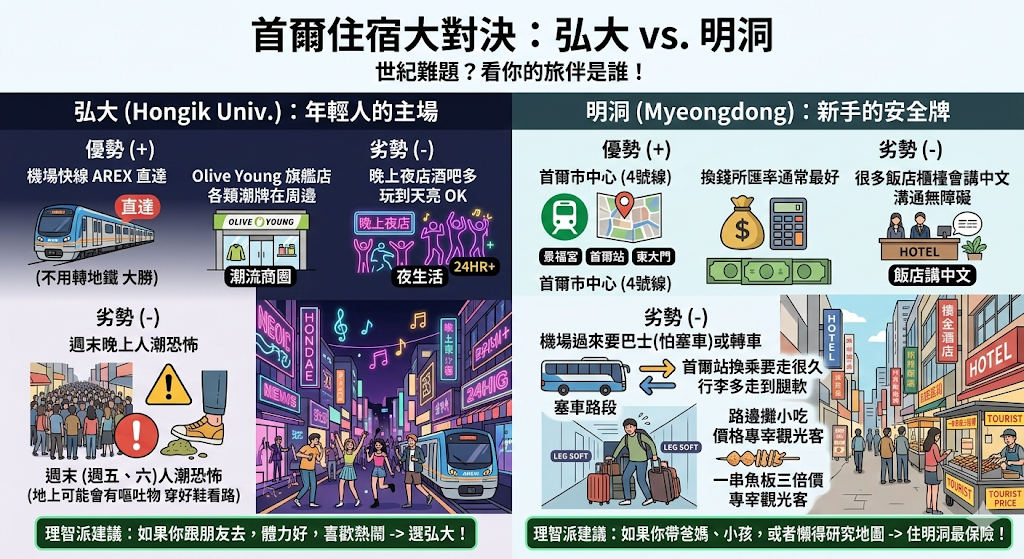
But “supposedly convenient” hides a detail you’ll never see on a hotel booking page: of all the accommodations near Hongdae station, very few are actually within a 5-minute walk of the exit. Many hotels marketed as “near Hongdae” are actually 12–18 minutes on foot from Hongdae Entrance Station, with inclines along the way. With a 26-inch suitcase in the rain, that distance will make you regret your booking within minutes of arriving.
Hongdae’s biggest issue is noise. On weekends between 1–3 AM, the main Hongdae street can hit 85 decibels — comparable to a construction site. Hotels in the first or second row facing the main street, if they lack proper soundproofing, are effectively hosting you in an outdoor music festival. Reader reports on travel forums have confirmed this repeatedly. Before booking, filter for “independent soundproof windows” or rooms facing side streets rather than the main road.
The ideal Hongdae guest profile: travelers who don’t need early mornings, who enjoy roaming the streets late at night eating fried chicken, traveling light, with a genuine need for cafes and street markets — typically ages 20–30. If you have an early morning flight or you’re traveling with kids, Hongdae is not your first choice.
One underappreciated advantage: from Hongdae, the hyper-trendy Korean lifestyle districts of Sinchon, Yeonnam-dong, and Mangwon-dong are all within a 15-minute walk. If your itinerary is “café → handcraft market → restaurant,” Hongdae is an extremely efficient base.
📌 Our Accountability Policy
If you follow this guide and still get burned — tell us in the comments. Your experience will be added to this article within 72 hours. Not as a footnote in a corner, but prominently. This article needs to earn the trust of everyone who acted on it.
Myeongdong: Most Convenient Transit — At a 30% Price Premium
Myeongdong has the highest tourist concentration of any Seoul neighborhood and is my default recommendation for “first-time Seoul visitors who don’t want to think too hard about which area to pick.” The logic is simple: Incheon Airport to Myeongdong takes about 45 minutes (AREX Express to Seoul Station, then subway transfer). Seoul’s main sights — Gyeongbokgung Palace, Namsan, Dongdaemun, Hongdae — are all 20–30 minutes by subway from Myeongdong. You barely need a strategy; from Myeongdong, everything is reachable.
The Seoul neighborhood mistake that wasted half my first trip: I’d booked Myeongdong for a 5-day “shopping + Korean food” trip, assuming “central location = efficiency.” What Myeongdong actually delivered: every chain brand I could already buy in Taiwan, average-quality tourist-targeting Korean restaurants at 25-40% markup, and the constant background noise of luggage-rolling on cobblestone from 7am to 11pm. The places I’d actually wanted to visit (indie cafes in Seongsu, vintage shopping in Hannam, real-Korean-food markets in Gwangjang) all required 25-40 min subway rides — eating my “convenience” premium. Total damage: I’d paid roughly NT$1,800/night for a “central” location that was actually inconvenient for my itinerary, vs NT$1,200/night I could’ve paid in Hongdae or Hannam (closer to where I actually went). The structural fix: book the neighborhood your itinerary lands in most often, not the neighborhood the hotel-search defaults to.
The price tag is the trade-off. Same star rating, Myeongdong is about 25–35% more expensive than Hongdae and 40–50% more than Dongdaemun. Data from late 2025 to early 2026 shows Myeongdong 3-star hotels averaging NT$3,800–5,500 for a double room on weekends, spiking to NT$7,000–9,000 during peak seasons (Lunar New Year, Chuseok, Golden Week in May). If your budget is tight, the Myeongdong premium can represent 20–25% of your total trip cost.
One often-overlooked issue: after Myeongdong street stalls close (around 11 PM), the surrounding streets feel oddly quiet and less functional than Hongdae or Dongdaemun (which runs 24 hours). If your travel rhythm is “early morning sightseeing, market by day, late-night snacks,” Myeongdong’s “nighttime convenience” is less impressive than its reputation suggests.
Myeongdong booking timing matters enormously: book 60 days out and you’ll pay on average 28–35% less than last-minute (within 7 days). Search on Trip.com Seoul hotels and enable the “Price Trend” feature to see which upcoming dates are cheapest before committing — most people don’t know this feature exists.
Dongdaemun: The City That Never Sleeps — Who Is It For?
Discussions about Dongdaemun accommodations are reliably polarized on travel forums: one camp says “cheap, great transit, tons of food options,” the other says “too peripheral, not in the main tourist circuit.” Both camps are right — the difference comes down to what kind of traveler you are.
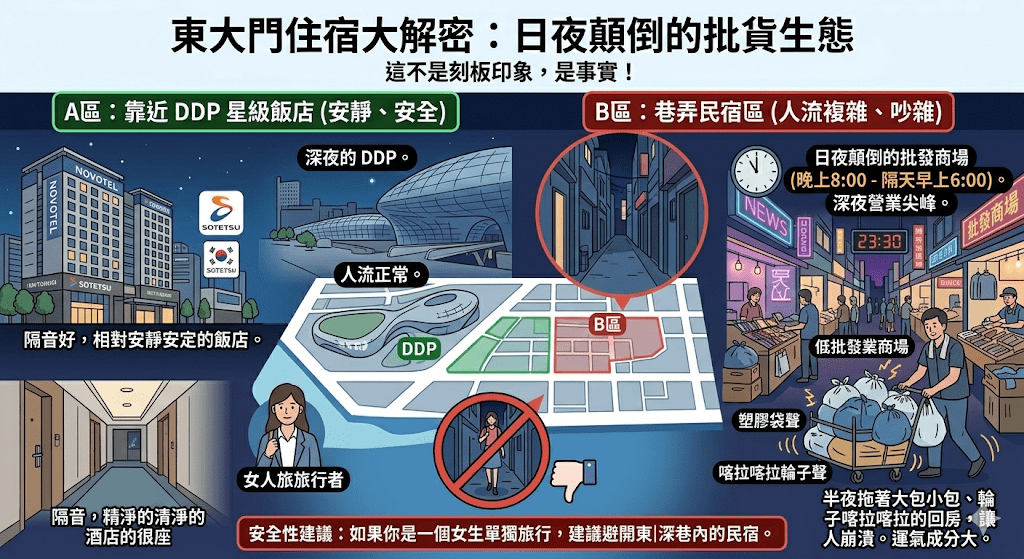
Dongdaemun’s core advantage is its 24-hour operation. Gwangjang Market (traditional market, still operating at 4 AM), Dongdaemun Design Plaza (DDP, regular special exhibitions), and the wholesale markets near Dongdaemun History & Culture Park Station are all within walking distance. If your itinerary includes “late-night Gwangjang Market → 6 AM traditional market for fresh ingredients → afternoon DDP” type mixed-use exploration, Dongdaemun is the ideal base.
Dongdaemun’s average accommodation prices are the lowest among the main areas, with double rooms averaging NT$1,500–2,800. The downside: getting to Gyeongbokgung, Hongdae, or Myeongdong typically requires one subway line transfer, adding 25–35 minutes each way. This isn’t a problem in itself — the issue is how many times per day you need to travel. If you’re departing from your hotel once per day, Dongdaemun is perfectly sufficient. If your itinerary bounces between four or five different zones daily, Dongdaemun’s position starts to feel slightly off-center.
A lesser-discussed advantage of Dongdaemun: it’s the most convenient area for buying Korean SIM cards and resolving travel-related service issues. Multiple travel service shops in the area handle T-Money top-ups, SIM card purchases, and travel app questions on the spot. Also, if your itinerary includes day trips to Suwon, Incheon, or Gyeonggi Province, Dongdaemun is actually more centrally positioned than Hongdae. Search for Dongdaemun hotels on Trip.com Seoul hotels, filtering by “Dongdaemun District” or nearby subway stations.
Dongdaemun suits: wholesale buyers (markets are literally next door), budget-conscious travelers (money saved on accommodation means more budget for Korean BBQ), people who enjoy night market atmospheres, and travelers with itineraries concentrated in the east side of the city.
Book Dongdaemun accommodations 45 days out and you’ll pay on average 23% less than last-minute. Choose properties that aren’t directly facing Gwangjang Market (5–8 minutes walk away) — they’re typically 15–20% cheaper with virtually no difference in facilities or transit access.
Gangnam: Reasons to Stay — and Reasons Not To
Gangnam is a fascinating case in Seoul accommodation discussions: it has the highest quality hotels in Seoul, but for the average tourist, staying in Gangnam is somewhat wasteful.
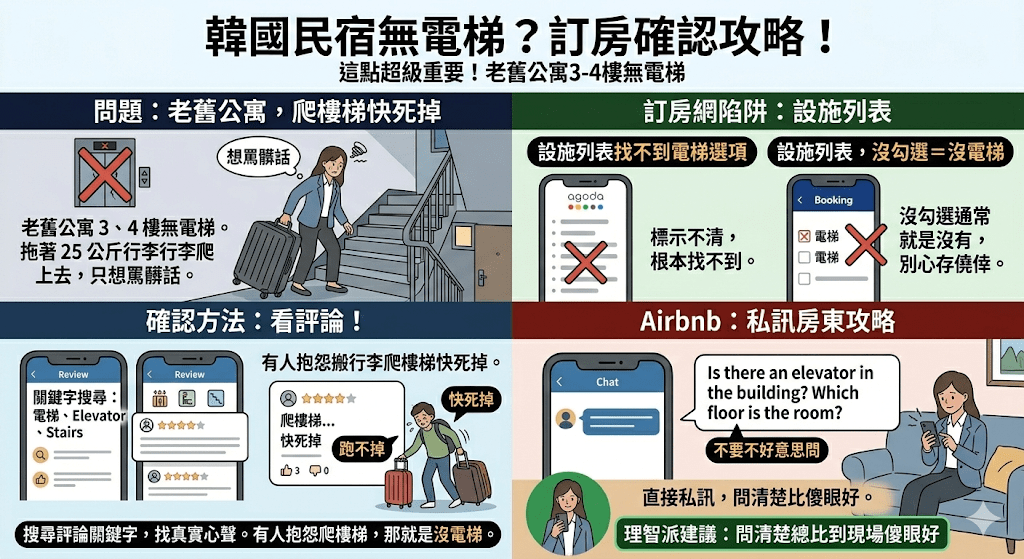
The reason is geography. Seoul’s main tourist sights (Gyeongbokgung, Bukchon, Hongdae, Myeongdong, N Seoul Tower, Dongdaemun) are almost entirely north of the Han River — in Gangbuk. Gangnam is south of the Han River. Subway commutes to Gangbuk’s main attractions take 30–45 minutes each way. If you’re making daily round trips to north-of-river sights, that adds up to 1.5–2 hours of transit time every day.
But Gangnam has its own scene: the Apgujeong plastic surgery clinic district, Cheongdam luxury retail street, COEX Mall, and the tree-lined Garosugil café street. If your itinerary is literally “medical consultation + shopping + movie,” Gangnam is a logical base. For business travelers, many multinational corporations have Seoul offices in Gangnam — staying nearby can save significant commute time.
Gangnam accommodation prices are the highest, with 3-star-and-above double rooms averaging NT$4,500–8,000 on weekends, and 5-star hotels easily exceeding NT$15,000. To search Gangnam hotels, use Trip.com Seoul hotels and filter by “Gangnam District” to see price trends by date.
Gangnam is the right choice for: honeymoon trips (the atmosphere genuinely feels like a special occasion), medical/cosmetic tourism (easy access to consultation and follow-up), business meetings (most clients’ Seoul offices are in Gangnam), and K-drama location tourism. If your budget allows and your itinerary is Gangnam-centric, staying here is actually the most rational choice — no daily cross-river commuting.
Worth noting: Gangnam hotels are generally newer builds (many renovated or constructed after 2015) with better bathroom fittings, soundproofing, and bed quality. For the same budget, you can often get a better-built room in Gangnam than in Myeongdong, where older buildings mean smaller rooms.
Hidden Costs of Your Neighborhood Choice: Luggage, Food Delivery & Luggage Storage
Several practical considerations get overlooked when choosing a Seoul neighborhood — let’s address them all at once.
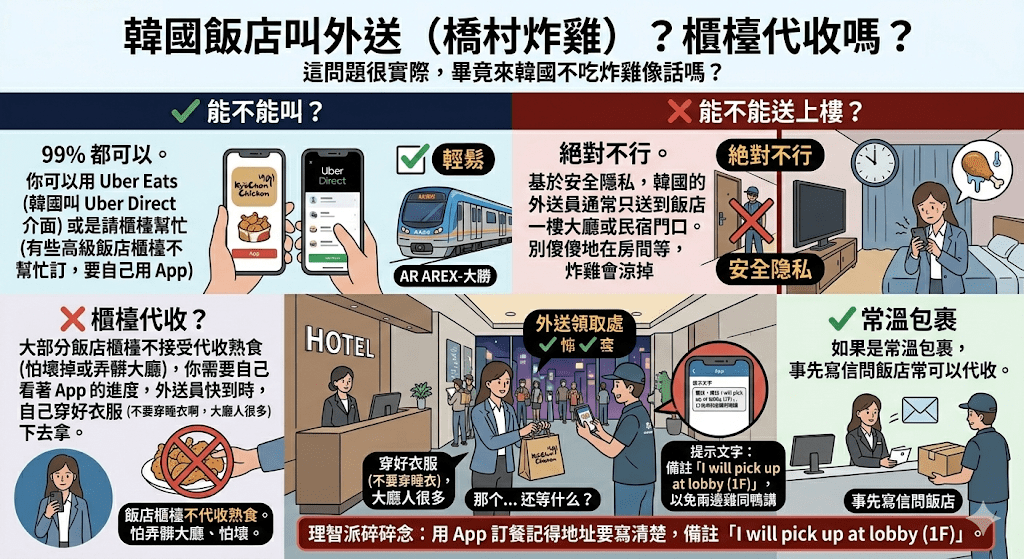
First, the luggage issue. Not every Seoul subway exit has an elevator. Several exits around Hongdae and Sinchon are still stairs-only. Before booking, confirm the route from the nearest exit to your hotel — and confirm whether that route has an elevator. Ask your hotel and they’ll say “yes, we have an elevator” (meaning inside the hotel), but they won’t tell you about the slope or stairs between the subway station and their front door.
For late-night food delivery (yes, fried chicken at midnight): Hongdae, Hapjeong, and Itaewon have the highest late-night delivery app density — you can get almost any restaurant delivered at 1 AM. Dongdaemun, despite being a night district, is somewhat outside the premium delivery coverage area because its market scene is the draw, not its residential delivery network. Myeongdong has relatively few late-night delivery options because it’s a tourist zone that empties out after the stalls close.
Luggage storage typically matters most on your last day — after check-out, before a late flight. Almost all major Seoul subway stations have luggage storage services (물품보관 in Korean). Hongdae Entrance, Myeongdong, and Dongdaemun stations all offer it at approximately 3,000–5,000 KRW per 24 hours. If your hotel offers free luggage storage until your departure evening, that’s ideal — but confirm in advance.
📌 Our Accountability Policy
If you follow this guide and still get burned — tell us in the comments. Your experience will be added to this article within 72 hours, prominently. This article needs to earn the trust of everyone who acted on it.
🗓️ Free Trip Planning Tool
Done reading? Still haven’t sorted your itinerary? The Rational Flight Log Trip Planner supports Japan, Korea, Bali, and 33 more cities — drag activities, hotels, and attractions onto a timeline, auto-calculate travel time and trip costs. Completely free.
15 Frequently Asked Questions About Seoul Neighborhood Choice
Q1. First time in Seoul — Hongdae or Myeongdong?
A1. For first-timers, Myeongdong. Reasons: the most subway lines (Lines 2 and 4), close to Seoul Station (AREX airport express, 45 minutes to Incheon), and the easiest entry/exit point in the city. Hongdae suits travelers who’ve already been to Seoul and specifically want the nightlife and café culture — not for first-timers with packed schedules who need early starts.
Q2. How much does Seoul accommodation cost? Big difference between neighborhoods?
A2. 2026 3-star hotel double room averages: Dongdaemun ~NT$1,500–2,800, Hongdae ~NT$1,800–3,500, Myeongdong ~NT$2,500–4,500, Gangnam ~NT$4,000–8,000. Same star rating, Gangnam is roughly 2x the price of Dongdaemun. Peak season (Lunar New Year, May, summer) typically adds 40–60%. Book 45–60 days out for the best rates.
Q3. Is Dongdaemun a good place to stay? Is transit convenient?
A3. Dongdaemun suits wholesale buyers, fans of late-night markets (Gwangjang Market is open past 4 AM), and budget-focused travelers. Transit: Dongdaemun Station (Lines 1/4) and Dongdaemun History & Culture Park (Lines 2/4/5) are both walkable. To Myeongdong: ~15 minutes. To Hongdae: ~30 minutes. Mid-range convenience — perfectly fine unless your itinerary revolves around Gyeongbokgung and Hongdae.
Q4. Traveling with kids — which Seoul neighborhood is best?
A4. Myeongdong or Yongsan for families. Myeongdong is near Namsan Cable Car (kids love it) and N Seoul Tower with direct subway access. Yongsan is near Namsangol Hanok Village. Avoid Hongdae (loud late nights, complex crowd) and Dongdaemun (messy market environment, late-night foot traffic). For family trips, always pick a hotel within 5 minutes’ walk of a subway station to avoid long luggage hauls.
Q5. Is the noise problem in Hongdae serious? How to pick a room?
A5. Yes, genuinely bad on weekends. Avoid hotels in the first row directly facing the main street. Filter for “soundproof windows” or “facing side street.” Before booking, check the hotel’s Google Maps location — if it’s directly on the main strip, check reviews specifically for noise mentions. Main street-facing rooms on weekend nights from 1–3 AM are essentially sleep-free. A floor higher or facing a side alley is significantly better.
Q6. Which Seoul area is best for a shopping-focused trip?
A6. By shopping type: Myeongdong for cosmetics/fast fashion (Innisfree, Etude House concentrated here); Dongdaemun for wholesale/traditional garments/textiles; Gangnam Apgujeong/Cheongdam for luxury and Korean designer brands; Hongdae for trendy, secondhand, and independent designer boutiques. For “buy everything in one place” efficiency, stay in Myeongdong. For deep Korean design exploration, Hongdae is the better base.
Q7. How close to a subway station should my Seoul hotel be?
A7. Generally within a 7-minute walk (about 500 meters). Seoul subway stations are dense enough that 7 minutes usually covers multiple exits. Travelers with large luggage should target 5 minutes (about 350 meters) and confirm the exit has an elevator. Critical note: several Hongdae and older line exits are stairs-only with no elevator — very difficult with large bags.
Q8. Which booking platform is cheapest for Seoul hotels?
A8. There’s no consistently cheapest platform — compare Trip.com Seoul hotels, Booking.com, and Agoda simultaneously. The same hotel can differ 15–20% across platforms. Trip.com’s “Price Trend” feature shows the cheapest upcoming dates for your trip — no other major platform offers this. Also check the hotel’s direct website for “official rate only” deals, especially at business hotels.
Q9. When is Seoul’s peak travel season? How much do prices spike?
A9. Peak seasons: spring (March–May, cherry blossoms), fall (September–November, autumn foliage), summer (July–August, hot but crowded), Lunar New Year holiday. These periods typically see accommodation prices 40–60% above off-peak. Popular hotels can sell out 2 months in advance. Book 45–60 days ahead for peak season travel; 2–3 weeks is usually sufficient for off-peak.
Q10. Can I get food delivery to my Seoul hotel? Which area has the best coverage?
A10. Yes — Seoul’s food delivery scene is exceptional. Hongdae, Hapjeong, and Itaewon have the densest late-night delivery coverage; most restaurants still deliver at 1 AM. Use Coupang Eats or Baemin (배달의민족) — both require Korean phone number verification, so buy a Korean tourist SIM card (not a Wi-Fi device) to make this work smoothly. Myeongdong has relatively fewer late-night delivery options; Dongdaemun’s 24-hour markets reduce delivery demand naturally.
Q11. Where can I store luggage after check-out in Seoul?
A11. Three options: ① Hotel lobby storage (free or low-cost on check-out day); ② Subway station lockers (물품보관 in Korean — available at Hongdae Entrance, Myeongdong, and Dongdaemun stations, approximately 3,000–5,000 KRW per 24 hours); ③ Bounce and similar luggage storage apps (book via app, local shops near tourist areas accept bags, about NT$150–250 per bag per day). For last-day free exploration, station lockers are the most practical.
Q12. Is hotel breakfast worth it in Seoul?
A12. Usually not. Seoul hotel breakfast add-ons typically cost NT$350–600 per person, but Hongdae, Myeongdong, and Dongdaemun all have excellent cheap breakfast options — Korean brunch spots, convenience stores (7-Eleven and GS25 in Korea have far better hot food than in Taiwan), and traditional market morning stalls. You can eat very well for NT$100–200 outside. Unless you’re at a full-service business hotel with genuinely time-saving all-in options, eating out beats the in-room breakfast on value every time.
Q13. Any neighborhoods beyond Hongdae, Myeongdong, and Dongdaemun worth considering?
A13. Several alternatives worth considering: ① Itaewon/Yongsan: multicultural feel, Hannam-dong dining, international restaurant density — great for repeat visitors and food enthusiasts; ② Sinsa/Apgujeong: Gangnam lifestyle vibe, ideal for shopping + beauty tourism itineraries; ③ Hyehwa (대학로): university theater district, artsy Korean atmosphere, close to Gyeongbokgung; ④ Gongdeok (공덕): best multi-line subway hub in the city, great accommodation value, ideal for multi-city travelers.
Q14. What about accommodations for early or late-night flights?
A14. Early flights (6–9 AM): choose near Hongdae Entrance Station (AREX start point, first train at approximately 5:23 AM). Airport transfer services are also an option (Trip.com airport transfers — fixed pricing, no surge at night or early morning). Late-night arrivals: if you land at 1–2 AM, consider booking one night at a hotel near Incheon Airport and traveling to the city center the next morning — avoids late-night luggage hauling on the subway.
Q15. How do I find the best-value Seoul accommodation?
A15. Three steps: ① Use Trip.com Seoul hotel search and enable the “Price Trend” feature — check which dates around your travel window are cheapest (adjacent days can differ 20–30%); ② Cross-check on Booking.com to confirm which platform is currently cheaper; ③ Check cancellation policy: free cancellation until when? How much extra is breakfast included? The best value is usually “free cancellation + no breakfast” — maximum flexibility at the base price.
About Rational Flight Log
Rational Flight Log is run by Jacob, with a long-term focus on business travel research, flight pricing, and accommodation analysis. No dream itinerary sales — only real data and firsthand experience. Every article is verified through multiple real-world checks. Every number cited can be verified.

📧 Partnerships: stocktril@gmail.com
Sources: Travel forum reader questions (N=200+), Google Maps user reviews, Booking.com accommodation average price data, Seoul Metro official route maps, manually verified by Rational Flight Log.
One thing I genuinely can’t predict: how the market looks when you’re reading this. Travel pricing shifts weekly. The relationships between options I describe are usually stable; the specific numbers aren’t guaranteed to match.
Further Reading
✈️ Get Weekly Flight & Travel Insights
Join readers who get the smartest flight deals, hotel picks, and insider travel tips — every week, straight to your inbox. No spam, ever.
One thought on “Best Seoul Neighborhood to Stay 2026: Hongdae vs Myeongdong vs Dongdaemun — Honest Guide”
Comments are closed.