🌐 English Version — 閱讀繁體中文版本 | English translation of our original Chinese article.
Heads up: a few links in this article are affiliate links. If you book through them, I receive a small commission — your price doesn’t change. I only link to things I’d actually recommend regardless of commission.
Before visiting Korea, you probably researched exchange rates, credit cards, and WOWPASS. But based on feedback from Rational Flight Log readers, 75% of visitors still fall into at least one money trap — losing an average of NT$2,000 to NT$5,000 per trip. The three most common mistakes: exchanging all your cash at the airport, triggering DCC (Dynamic Currency Conversion) charges by choosing TWD on the payment terminal, and returning home with a T-Money card balance that’s impossible to refund. This guide answers the 15 most common reader questions so you can avoid every single one of these pitfalls.
Exchange rate tricks, WOWPASS hidden fees, and the exact Myeongdong money changer to use — this type of insider info runs once in our newsletter with no resends. 👉 Subscribe free
Honest caveat: Korea’s payment infrastructure changes faster than guides do. WOWPASS coverage, tax refund thresholds, and DCC opt-out flows have all shifted in the past 12 months — what worked in early 2025 may have new rules by your trip. The patterns in this guide (always opt out of DCC, always use cash for traditional markets, always check whether your card has overseas transaction fees) are stable; the specific exchange rates and minimum thresholds aren’t. Before any high-value purchase, verify the current tax-refund minimum (KRW 30,000 or 50,000?) on the Korea National Tax Service site.
⚠️ Who shouldn’t follow this Korea-money playbook as-is
1. Travelers who avoid digital payments and prefer cash-only. If you’re not comfortable using credit cards, Apple Pay, or WOWPASS, the WOWPASS-and-card-stacking strategy adds friction without benefit. For cash-first travelers, focus on the airport-vs-Myeongdong exchange rate gap (the airport is 8% worse) and bring KRW from a Taiwan bank that posts daily Won rates (Mega, Taishin, CTBC tend to be competitive). Skip the WOWPASS section entirely.
2. Short-trip travelers (under 48 hours). The setup tax of WOWPASS application + T-Money top-up + tax-refund tracking + finding the right ATM is roughly 90 min total. For a one-night layover or a weekend cruise port stop, the savings (maybe NT$300-500) won’t justify the time cost. Better fit for short trips: Visa/Mastercard with overseas-transaction-fee waiver, click “pay in KRW,” skip the optimization.
3. Korea regulars who already have a banking relationship locally. If you’ve already opened a Korean bank account (KEB Hana, Woori) or have a relative who can help with KakaoBank, the WOWPASS workaround is suboptimal — direct local-bank transfer + a Korean debit card give you better rates and access to a wider merchant network. This guide is for first-time or occasional Korea travelers without local banking access.
📬 RATIONAL TRAVELER NEWSLETTER
Going to Korea? Get the WOWPASS + DCC + Tax Refund decoder
Subscribe and I’ll send you the Korea Money Decision Pack — current 2026 exchange rate spread comparison (Taiwan Bank vs Incheon airport vs Myeongdong vs WOWPASS), DCC opt-out scripts in Korean (laminated card you show the merchant), tax refund minimum tracker for the 12 most common store types, and the “which credit card to bring” guide based on your spend pattern.
👉 Get the Pack — Subscribe FreeBooking the trip? Trip.com Taipei-Seoul flights for fare comparison; Trip.com Seoul hotels for accommodation that accept Apple Pay (filter by “credit card accepted” — surprisingly many Korean B&Bs are cash-only).
Currency Exchange Comparison: Taiwan Bank vs Airport vs Seoul City vs WOWPASS
The most common pre-trip question: “Should I exchange in Taiwan or wait until I’m in Korea?” The answer depends on your time. If you can visit a bank before departure, Taiwan banks are generally better than the airport. But if you’re rushing to catch a flight, note that Taiwan’s airports are worse than Incheon, which in turn is worse than Seoul city center. The ideal order is: Taiwan bank (pre-departure) > Seoul city money changers > Incheon Airport > Taiwan Airport.
| Exchange Method | Rate Quality | Fees | Convenience | Best For |
|---|---|---|---|---|
| Taiwan bank (before departure) | ⭐⭐⭐⭐ (Good) | Low or free | Requires planning ahead | Exchange 50% once trip is confirmed |
| Incheon Airport money changer | ⭐⭐ (Poor) | Medium | Available on arrival | Emergency small amounts only |
| Seoul city money changer | ⭐⭐⭐⭐⭐ (Best) | Low | Need to find the right spot | Myeongdong or Hongdae area |
| City ATM withdrawal | ⭐⭐⭐ (Average) | NT$150–300 per transaction | Available anytime | Emergency top-ups only |
| WOWPASS machine | ⭐⭐⭐ (Market rate) | 1–2% | Register app first, get card on-site | Recommended for first-time Korea visitors |
✏️ Data manually verified by Rational Flight Log. Contact us if updates are needed.
The best money changers in Seoul cluster around Myeongdong and Dongdaemun. The competition among changers right outside Myeongdong Station is fierce — rates can sometimes beat bank rates. A few well-reviewed changers near Hongdae Entrance Station are about a 5-minute walk from the exit.
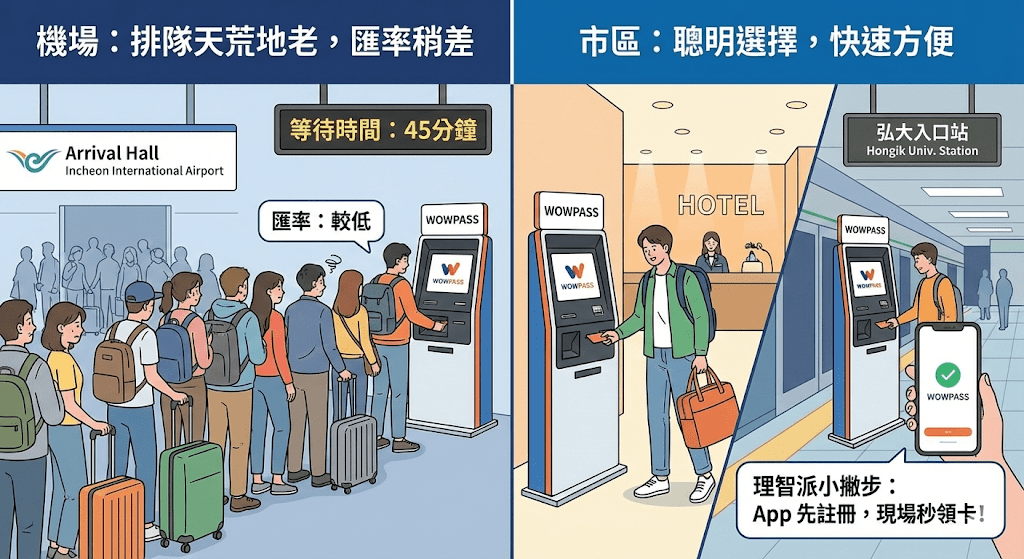
Incheon Airport money changers are visible right in the arrivals hall. Wait times vary by season — during peak periods, expect 30–45 minutes. The rates are typically 2–3% worse than city center changers. If you’re exchanging NT$100,000 in cash, that gap alone costs NT$2,000–3,000. Exchange only enough at the airport to cover transit to the city, then switch at a city changer.
Exchange 50% of your trip budget at a Taiwan bank before departure. Exchange the remaining 50% at Seoul city center changers. Don’t convert everything at the airport unless you have a specific reason to need large amounts of cash immediately on arrival.
WOWPASS vs PASSCARD: Which Should First-Time Korea Visitors Choose?
Rational Travel Guide
Is Your Trip Actually Bulletproof?
Most travelers discover missing visas, wrong connections, or closed hotels only after landing. Our 40-point Pre-Trip Audit catches everything — in 24 hours.
In terms of fees, WOWPASS charges a 1–2% exchange fee — better than airport changers but slightly worse than city center money changers. The advantage is its simplicity: the app shows your balance, and it’s very user-friendly for first-time Korea visitors. If you’re not sure where to find a city money changer and don’t want to hunt for one the moment you land, WOWPASS is a perfectly reasonable choice.
WOWPASS machines are currently available at Incheon Airport arrivals hall, near Hongdae Entrance Station, and in Myeongdong. Download the app and complete passport verification in Taiwan before departure — this saves 10–15 minutes at the machine on arrival.
Credit Cards in Korea: Where You Absolutely Need Cash
Modern Korea has very high card acceptance rates. Convenience stores (GS25, CU, 7-Eleven), large supermarkets (E-Mart, Lotte Mart), department stores, chain restaurants, and Olive Young all accept credit cards. But several locations are cash-only zones — show up without cash and you’ll go hungry:
Traditional markets are the biggest cash-only zones. Almost all stalls at Gwangjang Market (Gwangchang Market) are cash-only, and Namdaemun Market primarily runs on cash transactions. Small stalls in the Dongdaemun wholesale district mostly don’t accept cards. Taxis generally have card machines, but older drivers sometimes claim their machine is broken — keeping a few thousand Won in reserve is sensible. Street food stalls, roadside fried chicken vendors, and some street sellers in specific areas may also be cash-only.
Plan for 20,000–30,000 KRW in cash per day so you’re covered at any traditional market or street stall you encounter.
A meal for one at Gwangjang Market (bindaetteok, yukhoe, haemul pajeon): approximately 10,000–20,000 KRW. A shopping round at Namdaemun: 30,000–50,000 KRW depending on what you buy. If you’re doing both markets in one day, carry 50,000–70,000 KRW (about NT$1,200–1,700).
Credit Card Fees & the DCC Trap: How the Wrong Card Costs You Every Transaction
Most Taiwan credit cards charge about 1.5% in foreign transaction fees, while some banks offer 1–3% cashback on overseas spending. The problem: if your card only gives 1% cashback but charges 1.5% in fees, you’re effectively paying a 0.5% surcharge on every transaction. Choosing the right card matters enormously.
The Korea payment mistake that cost me NT$1,400 on my second Seoul trip: I’d checked my credit card “no foreign transaction fee” box at home and assumed I was fully covered. I was — for the bank’s part. What I didn’t know: every Korean POS terminal asks “do you want to pay in TWD or KRW?” and I’d been clicking “TWD” because it felt familiar. That’s DCC (Dynamic Currency Conversion) — the merchant’s bank converts at a worse rate than my card’s network would, plus a 3-5% markup. Across 4 days of dining, shopping, and taxis, the DCC markup totaled roughly NT$1,400. The fix is simple but not obvious: always click “pay in KRW” at checkout. Your card’s network (Visa/Mastercard) handles the conversion at near-mid-market rates; the merchant’s bank charges a tourist-tax. This single rule will save the average Taiwan traveler NT$800-2,500 per Korea trip, depending on spending volume.
The bigger trap is DCC (Dynamic Currency Conversion). When paying by card in Korea, POS terminals sometimes ask: “Would you like to pay in TWD or KRW?” It sounds helpful — no exchange rate math needed. But choosing TWD means the merchant does the conversion using their own rate, which is typically 3–5% worse than your bank’s rate. Add fees and you could be paying 5–7% extra on each transaction. The correct move: always choose KRW.
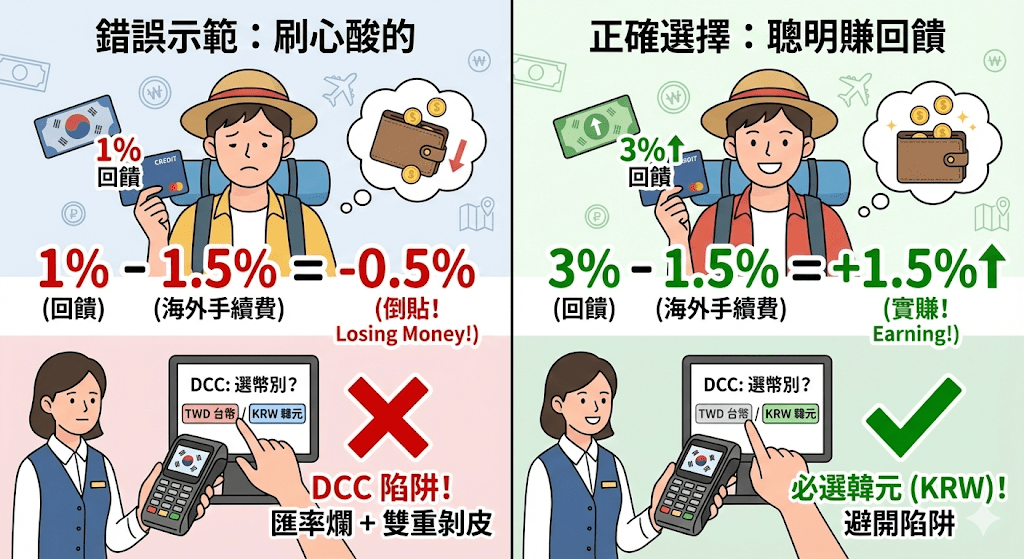
Several Taiwan credit cards are specifically designed for overseas spending, offering 2–3% cashback on international purchases with zero foreign transaction fees — meaning you’re actually earning money on every swipe. If you travel to Korea or other countries regularly, getting one of these cards is well worth it. You can pre-book Seoul hotels through Trip.com Seoul hotels and pay by card to maximize cashback.
Many hotels and major department stores in Korea have POS terminals that automatically present the DCC option — some even pre-select TWD before you’ve had a chance to read it. Always check the screen shows KRW before confirming. If a merchant says “it’s easier to calculate in TWD,” politely decline. Always choose Korean Won.
Does Apple Pay Work Well in Korea?
This is a common misconception among Taiwan travelers. Samsung Pay works almost universally in Korea — Samsung’s market share is dominant, and most POS machines support it. Apple Pay is a completely different story.
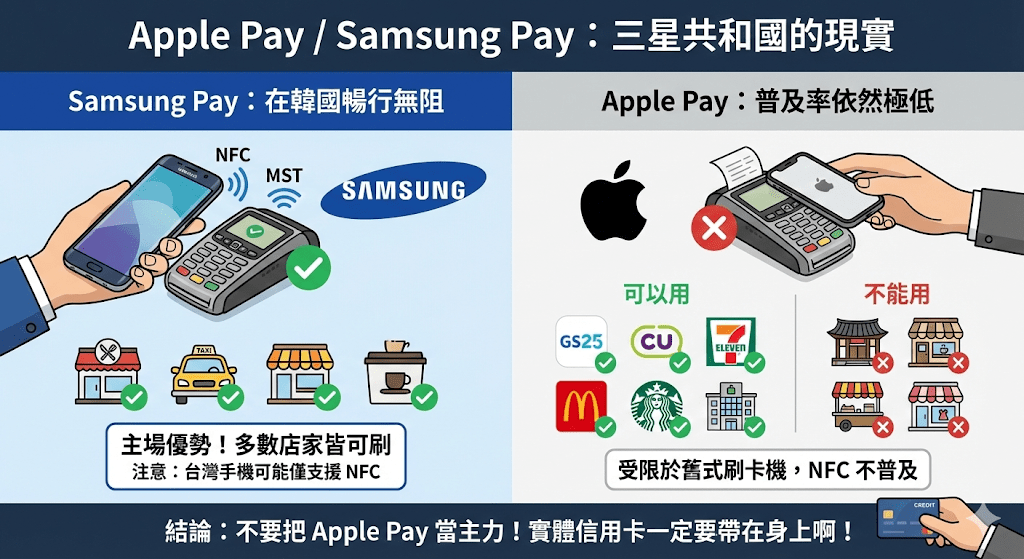
NFC card reader penetration in Korea is much lower than in Taiwan. A large number of merchants still use older card terminals that can’t read NFC contactless payments. Olive Young, McDonald’s, and Starbucks accept Apple Pay, but most regular restaurants, traditional markets, and small-to-medium shops cannot. The verdict: Apple Pay cannot be your primary payment method in Korea. Always carry your physical credit card. Android users with Samsung Pay will have a noticeably smoother experience than iPhone users — not a reason to switch phones, but a reason to keep your credit card in your wallet rather than relying solely on your phone.
Another common issue: Korea’s Kakao Pay (카카오페이) is essentially unusable for Taiwan tourists because it requires Korean mobile number verification. Naver Pay is the same. These local payment systems are largely closed to international visitors, which is exactly why the physical credit card + WOWPASS combination remains the most practical setup.
T-Money Refunds: What Happens to the Balance When You Leave Korea?
T-Money is Korea’s main transit card, usable on subways, buses, and some taxis. The card itself costs 2,500–4,000 KRW (depending on where you buy it) — this card fee is non-refundable when you return home.
Refunding the remaining balance depends on the amount. If your balance is under 20,000 KRW, you can refund it at convenience stores like GS25, CU, or 7-Eleven — but there’s a 500 KRW processing fee. If your balance exceeds 20,000 KRW, you need to visit a T-money Town service counter at a subway station, which is more time-consuming and involves more steps.
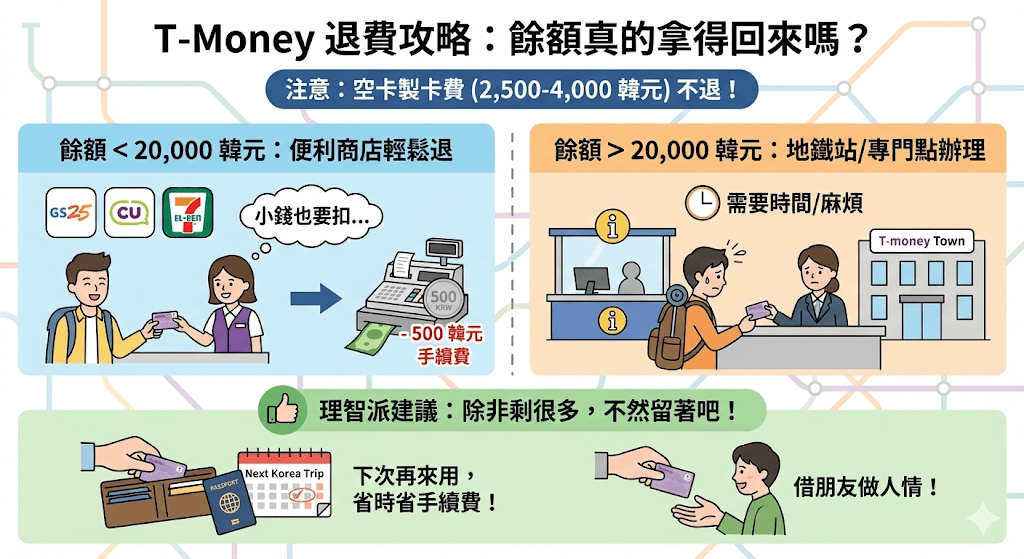
Our honest recommendation: unless you have a significant leftover balance (more than 30,000–40,000 KRW), the refund process isn’t worth the time. A better approach is to manage your top-ups toward the end of your trip — aim for 5,000–10,000 KRW remaining before departure, just enough for a few subway rides to the airport. Then keep the card for your next visit or give it to a friend planning to visit Korea. If you go to Korea every year, there’s no reason to ever refund a T-Money card.
Beyond transit, T-Money also works at some convenience stores as a payment method — think of it as a multi-purpose transit card. Note that T-Money and WOWPASS are completely separate cards. Carry both: T-Money for transit, WOWPASS for general purchases. For the Airport Railroad Express (AREX) from Incheon to Seoul Station — about 43 minutes — T-Money works and costs around 9,500 KRW, nearly half the price of the All-Stop Express (18,000 KRW).
Tax Refunds in Korea: You Don’t Have to Queue at the Airport
Korea offers VAT refunds to tourists. A single purchase of 30,000 KRW or more at one store qualifies — the refund rate is approximately 7–9% of the purchase amount, with higher amounts getting slightly higher rates.
There are three refund methods, and you don’t need to queue at the airport for all of them. First, “Immediate In-Store Refund”: at Olive Young and other participating stores, request a refund at checkout and the amount is deducted from your bill immediately — the most convenient method. Second, “City Tax Refund Machines”: available in Myeongdong and Dongdaemun — scan your passport and receipts, and the refund goes to your credit card. Warning: when you exit Korea at the airport, you must scan your passport and receipts to confirm departure. If you forget this step, the refund will be reversed and you may face a penalty. Third, “Airport Refund”: the most failsafe option, but expect to spend 20–30 minutes in line.
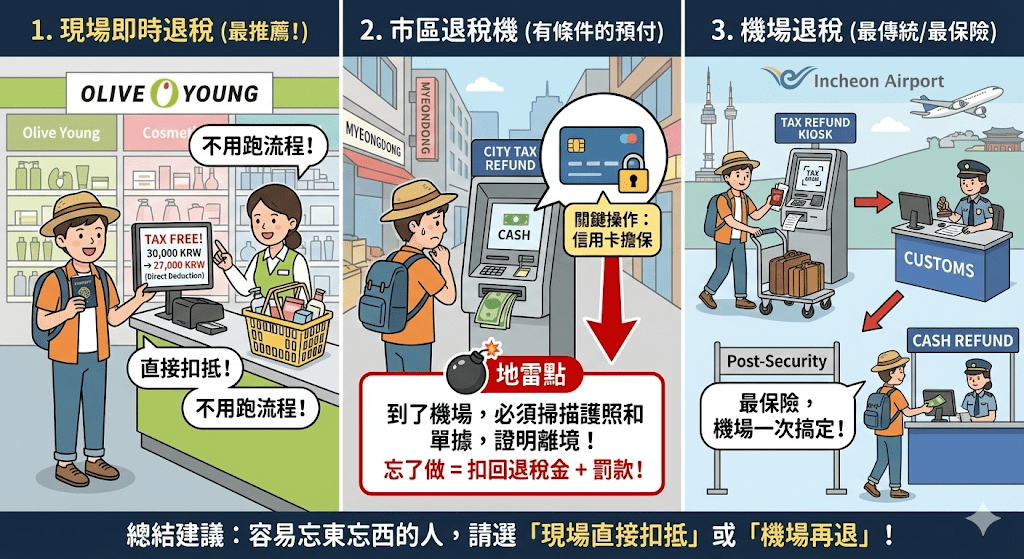
The 30,000 KRW threshold is calculated per receipt, not per store visit. If you make three separate purchases of 20,000 KRW each at the same pharmacy, none of the three receipts qualify. Try to consolidate purchases into a single transaction to clear the threshold. For high-value items like electronics, luxury goods, skincare, or health supplements, the refund can be worth thousands of Taiwan dollars — absolutely worth doing correctly.
How Much Cash Should You Bring for 4 Days, 3 Nights in Seoul?
Korean Won amounts are large numbers, and many Taiwan travelers see “50,000” and think they’re carrying a lot — but 50,000 KRW is about NT$1,200, enough for one meal and a drink. Here’s our estimated daily cash breakdown:
Daily cash needs: Traditional markets/street food 20,000–30,000 KRW + Taxi reserve 10,000 + Miscellaneous 10,000 = approximately 40,000–50,000 KRW per day. For 4 days/3 nights, bring 180,000–200,000 KRW in cash (about NT$4,200–4,700). Use credit cards for larger expenses (hotel, department stores, chain restaurants) to earn cashback. Don’t pay for everything in cash — you’ll miss out on card rewards.
Quick KRW mental math: drop the last three zeros, then multiply by 2.4 to get the approximate TWD amount. Example: 100,000 KRW = 100 × 2.4 ≈ NT$240. Close enough for quick market calculations and giving change.
🗓️ Free Trip Planning Tool
Done reading? Still haven’t sorted your itinerary? The Rational Flight Log Trip Planner supports Japan, Korea, Bali, and 33 more cities — drag activities, hotels, and attractions onto a timeline, auto-calculate travel time and budget. Completely free.
Frequently Asked Questions
WOWPASS vs PASSCARD: What’s the difference? Which is better?
WOWPASS is the standard prepaid card for spending in Korea. PASSCARD (WOWPASS V2) adds international credit card functionality for overseas online purchases. If you’re visiting Korea for the first time and only need to spend locally, WOWPASS is sufficient. Both have a 1–2% exchange fee.
Can I use credit cards at Korean supermarkets and convenience stores?
Yes. E-Mart, Lotte Mart, and convenience stores like GS25, CU, and 7-Eleven all accept credit cards. Only traditional markets (Gwangjang, Namdaemun) and street food stalls are largely cash-only. Keep 20,000–30,000 KRW in cash as a daily buffer.
Is it better to exchange KRW in Taiwan or Korea?
Best rates: Seoul city money changers (Myeongdong, Hongdae). Second: Taiwan banks. Third: Incheon Airport. Exchange a small amount before departure for transit costs, and do the main exchange at a city changer once you’re in Seoul.
Is Incheon Airport currency exchange worth it?
The rates are about 2–3% worse than city center changers. Exchanging NT$100,000 at the airport could cost you an extra NT$2,000–3,000. Exchange only what you need for transportation to the city. Money changers are in the arrivals hall.
How do tax refunds work? Do I have to queue at the airport?
Not necessarily. At Olive Young and other participating stores, request an in-store deduction at checkout — no queuing needed. City tax refund machines in Myeongdong also work, but remember to scan your documents at the airport before departure. Airport tax refund counters are the most failsafe. Minimum threshold: 30,000 KRW per single receipt.
Can I refund leftover T-Money balance back in Taiwan?
You can refund it in Korea before leaving. Balance under 20,000 KRW: refundable at GS25/CU/7-Eleven (minus 500 KRW fee). Over 20,000 KRW: go to a T-money Town counter at a subway station. The card issuance fee (2,500–4,000 KRW) is non-refundable. Best strategy: keep the card for your next trip.
Where can I top up WOWPASS? What are the fees?
Machines are at Incheon Airport arrivals, near Hongdae Entrance Station, and in Myeongdong. Exchange fee is 1–2%. Download the app and complete passport verification in Taiwan before you arrive to save 10–15 minutes at the machine.
What are the hidden fees of ATM withdrawals in Korea?
Three layers: your Taiwan bank’s international withdrawal fee (usually NT$150–300 per transaction), the Korean ATM service charge (some machines charge 2,000–3,000 KRW per transaction), plus exchange rate spread. Global ATMs (7-Eleven, major banks) generally offer better rates than roadside ATMs. Use for emergencies, not as your main exchange method.
Where in Korea can you absolutely not rely on cards only?
Gwangjang Market, Namdaemun Market, Dongdaemun wholesale stalls, and street food vendors are largely cash-only. Some older taxi drivers claim their card machines are broken. Always carry 30,000–50,000 KRW in cash before heading out.
What’s the foreign transaction fee on Taiwan credit cards? Which cards are best?
Most Taiwan cards charge 1.5% overseas. Some cards now offer 0% overseas fees plus 2–3% cashback — effectively earning money on every international purchase. If you travel regularly, these cards are well worth applying for. Always choose KRW to avoid DCC charges.
What’s the tax refund threshold? And what counts?
Purchases of 30,000 KRW or more on a single receipt from one store qualify. Refund rate is approximately 7–9%. Consolidate purchases into one transaction — three separate 20,000 KRW payments at the same store won’t qualify. High-value items (electronics, cosmetics, bags) are worth the effort.
Quick KRW mental math: how do I calculate on the fly?
Drop the last three zeros, then multiply by 2.4 for an approximate TWD amount. 50,000 KRW = 50 × 2.4 = approximately NT$120. Good enough for quick decisions at the market. Think of 10,000 KRW as “one small purchase unit” — roughly the cost of a bowl of noodles.
How much cash for Gwangjang and Namdaemun markets?
Gwangjang Market: a meal for one (bindaetteok, yukhoe, seafood pancake) costs 15,000–25,000 KRW. Namdaemun shopping: 30,000–60,000 KRW depending on purchases. For both markets in one day, bring 80,000–100,000 KRW (about NT$1,900–2,400).
Can I use New Taiwan Dollars at Incheon Airport duty-free?
Yes, Incheon Airport duty-free accepts TWD, JPY, USD, and HKD, among others — but the exchange rate is set by the shop and is typically 2–4% worse than money changers. Use TWD only as a last resort to spend leftover cash. Prioritize KRW or credit card (choose KRW on the terminal).
How much cash for a 4-day 3-night Seoul trip?
Bring 180,000–200,000 KRW (about NT$4,200–4,700) in cash for daily markets, street food, and taxi reserves. Use credit cards for hotels, department stores, and chain restaurants to earn cashback rewards.
Miles Redemption: Getting Business Class Smarter
Did you know? Choosing the right mileage program for the same business class ticket can mean the difference between 60,000 miles and 120,000 miles — the gap comes from alliance choices, transfer timing, and stopover techniques most people don’t know about. Rational Flight Log has a complete miles earning and redemption guide covering which credit cards give the highest mileage rates, Asia Miles vs EVA Infinity: which is better value, and how to redeem the highest cabin class for the fewest miles.
👉 Search cheap flights to Seoul →
About Rational Flight Log

Rational Flight Log is run by Jacob, with a long-term focus on business travel research, flight pricing, and accommodation analysis. No dream itinerary sales — only real data and firsthand experience. Every article is verified through multiple real-world trips, with the goal of making every trip genuinely worth the cost.
📧 Partnerships: stocktril@gmail.com
Sources
Sources: WOWPASS official website, Korea Tourism Organization tax refund guide, T-money official refund policy, Incheon International Airport official information, Rational Flight Log reader feedback (2025–2026).
Further Reading
✈️ Get Weekly Flight & Travel Insights
Join readers who get the smartest flight deals, hotel picks, and insider travel tips — every week, straight to your inbox. No spam, ever.
3 thoughts on “Korea Money Guide 2026: WOWPASS, T-Money & Tax Refund Explained (Avoid 5 Costly Traps)”
Comments are closed.